Wednesday, August 24, 2011

Rave down

The police in Spain have been busy lately, not only with repelling  political protest at the visit of the Pope to Madrid and the recent “Indignado” movement, but also in stemming the tide of revellers.
Last week in the Costa Brava town of Lloret de Mar, a stones throw away from where I saw the Rhythm and Sound gig, there were several nights of unrest  (this link also has a fantastic new video, in Spanish, but the images are impressive) stemming from the cancellation of a gig  by star DJ Tiesto. An electrical failure left the Colossos Club momentarily powerless, but the back up generator was only sufficient for music and minimal service, meaning no air conditioning. As temperatures soared, tempers flaired and the gig was stopped.


Outside on the streets the young (20-25 year old) people, mainly French, Italian and English tourists, the so called “Easyjetset”, apparently began to behave in a disorderly manner. Conflict with riot police continued for at least two nights with some ugly scenes and much soul searching. The small town is actually home to a large assortment of hotels, bars and nightclubs, designed especially to appeal to the low cost tourist, mainly young people from the north of Europe.


While the Easyjetset has been celebrated in Berlin for its knock-on effect on the local scene, in the Costa Brava the legacy does not appear the same. The role of cheap travel and the Berlin techno scene was celebrated in book “Lost and Sound: Berlin, techno and the Easyjetset“ by Tobias Rapp. A chapter from the book can be found on-line here.

Tiesto also played in the same week at Opium Mar, one of the posh summer discotecas on the Barceloneta beach front, about 50 metres from where I work. Recent and upcoming artists have or will include SebastiAn, Roger “The S man” Sanchez, Armin van Buurin and more. Tonight my colleague is going there to see Swedish DJ Eric Prydz, but she promised me she won’t be coming straight from the disco to work, despite the proximity. One of Prydz key tracks is the remix of “Call on me” which is based on Steve Winwood’s 1982 hit “Valerie”. Prydz track made number one in the UK and has the distinction of being the number one hit with the lowest amount of sales in a given week, largely due to the importance of downloads. Riots are also not new to Tiesto, with previous problems  at a gig in the US.


This week, the Spanish police were also involved, but much more passively,  in the tiny town of Molino de Duero (Soria), where 2000 youths from all across Europe descened into the nearby forest for Spaintek, a rough and ready party rather than music festival. Harmless, but definitely noise pollution say the neighbours in this funny video, even if you do not speak Spanish. It is hard to imagine 2000 people there from the footage, which seems to show about 20. But the police here should be praised for keeping things peaceful so far, despite the apparent illegality of camping.

Sunday, August 21, 2011

Festa Major de Gràcia

This past week has been the Festa Major of Gràcia, one of the most important neighbourhood festivals in Catalonia. The Gràcia district lies directly north west along the main central axis of Barcelona, leading from the port up La Rambla and towards the Collserola hills at the back of the city. The area was an independent town until 1897 when the great expansion “eixample” engulfed the area into the growing city. The festival is celebrated every year around the 15th August, day of the religious festival The Ascension. During the festival, the district is portioned into neighbourhood zones who each block off a part of one key street with a stage and a little bar and then decorate the area with an elaborate entrance and a temporary ceiling of lights and whatever comes to mind. Bands play music on the stage, varying from the traditional Catalan Sardana dance, to reggae, rock, funk, salsa and jazz. The best decoration, all made using recyclable and recycled material, is given a prize, while they neighbours come together to eat collectively and enjoy the shows.

One of the highlights of this year’s festival from a decorative point of view was the street Carrer Mozart leading from the square Plaça Villa de Gracia. The entrance featured a gigantic and insane looking Mozart, somehow reminiscent of the giant puppet used in the recent Serge Gainsbourg film. In a lovely touch of detail, his body was decorated with pages of sheet music, while behind him in the street hung many papier mâché figures, masks and painted CDs. My father often hangs CDs from fruit trees to scare away the birds, something one can never imagine doing in the late 80s when they first made their presence felt on the market.

As if not to be outdone, the stage at Carrer  Siracusa had gone all out, hanging a glut of vinyl records from the buildings and wires above the street, amongst them copies of Mike Oldfields “Tubular bells” as well as many different Catalan and Spanish 7” discs. No MP3s will ever hang here, but you have to wonder if symbolically this somehow represents something of the digital age?


One of the key events of the festival and an important part of Catalan identity is the sport of Castellers or Human Castles, which is performed by different suburban clubs on different occasions throughout the year, with an annual competition. As well as strength and unity (thereby perhaps, forming a symbol of Catalan identity politics in Castellers), successful castle building also requires music. As the Castellers climb over one another to reach the maximum height, a small group of musicians accompanies the erection with medieval flutes and drumming. The music is not merely incidental, but serves as a form of communication from the technical crew on the ground to the castellers who cannot look up or down to see how the castle is forming, but who must rely on cues from the music to know when the child reaches the pinnacle. Indeed, the public is often requested to remain relatively quiet during the construction to enable the castellers to better hear the music and thus communicate with their colleagues.


Check for the castle beginning around the 1:30 mark. The music begins once a certain stability of the base structure has been achieved and when the lower levels become “blind”. Note the change in music when the child reaches the summit, then the music resumes until the base is disassembled. For each type of castle the music is the same.
Except for crowd noise and the growing energy of an anxious or excited  public, one wonders why similar musical measures are not used in other sports? People often talk about rhythm and tiempo in football matches, for example, but nobody has ever tried beating on a drum to try and rhythmically pace a match, for example, much like galley slaves would use the beat to set their oars in rhythm.

Are you ready? or is this hyperreal?

Here is one of my favourite quotes from the recent coverage of the riots in England that have spread somewhat around the globe.

“a rage against exclusion from consumerist fulfilment”

from The Guardian

Back in Barcelona I could only look on captivated, excited and disappointed in the same breath. Given the current social, political and economic climate, it does not surprise me at all to see such behaviour and to a point I do not judge it too critically, but yet I have to feel a certain amount of disappointment at the lack of real political identity amongst the looters. The UK government is giving them a lot of credit where none is due, it seems to me, politicizing them and making them a coherent enemy when they seem nothing more than just a pack of angry dogs. This was no protest or statement against the political class, but merely a reaction from poor people (and probably many not so poor people) who are sick of being poor and who are told they will be even poorer due to economic mismanagement. The looting did not even have a Robin Hood element to it either, nothing but chaos. Also, much has been made of the use of Blackberry’s in organising and propagating the riots (see below), but shouldn’t owning a Blackberry be a sign of “consumerist fulfilment”?


The lack of political motivation in the English riots is also disappointing given the vulnerability of world governments in the face of the ever blooming financial crisis, but also given that so many other youths around the world have made impactual and, what seem to be, lasting political statements via the “Indignado” or 15M movement. Politically and socially motivated stand offs with police are also not unheard of in Britain, as the recent riots in Bristol’s Stokes Croft region showed.


The looters may seem to lack direct political motivation, but it appears there is strong evidence for their indirect or the collective action at least given the economic downturn and the enforced austerity measures put in place by many governments. A recent paper was published by Jacopo Ponticelli and Hans-Joachim Voth, two macroeconomic professors from the University Pompeu Fabra (UPF) in Barcelona, which studied 26 European countries from 1919 to 2009 and found that

“Expenditure cuts carry a significant risk of increasing the frequency of riots, anti-government demonstrations, general strikes, political assassinations, and attempts at revolutionary overthrow of the established order. While these are low-probability events in normal years, they become much more common as austerity measures are implemented.”

The obvious musical backdrop to this is punk rock and the now dubious decision to use the Clash’s song “London calling” in advertisements  for next year’s Olympic Games. Actually about nuclear war, nonetheless, the songs imagery ties in nicely with The Guardian’s dystopian view of the future.

“Images of the city's looted, burnt-out streets conjure not so much the 1980s Brixton riots as a new, dystopian reality”


The soundtrack to this brave new world might also do well to include Atari Teenage Riot who have sensibly decided to release a new album “Is this hyperreal?” in the midsts of all this after many years in the wilderness. Indeed, the album is much a search for identity for the band themselves as it is another brash and no-punches-pulled criticism of “consumerist fulfilment” and a call to action.


Alec Empire begins the idea of identity when intoning “Anonymous Teenage Riot” on several tracks, while Nic Endo provides a surprising moment of tenderness in “Shadow Idenity” when singing

“Who do you want to be and why?”

to a few bars of slow dreamy music as if addressing herself and the band as well as the listener. CX Kitronik is the most blatant however, beginning the track “Rearrange your synapses” with the monologue

“2011. Atari teenage Riot. And some people are still asking if we are still necessary. Very much so…”

Relevance is an important question as nobody seems to have paid much attention to ATRs music for long time, but CX Kidtronik is more than right when suggesting they are still necessary. While many of their old tropes may be found here, such as reams of noise, raking guitars, bullet beats and a certain comic book enthusiasm to the lyrics, there is enough innovation to the music (all recorded using an Atari ST1040 computer with 2MB ram) to keep it relevant, such as more emphasis on ambience, a variation of beat styles, from techno to the dub step influence on “Digital delay”. Closing track “Collapse of History” is a beautifully ironic party track, rough, but almost surreptitiously creating the contrasting sense of glamour and hands in the air joy to celebrate the end of civilisation.


Politically, and coming back to the riots in Britain, ATRs attack on the internet in general and social network culture is the most prominent addition to their list of targets.

“The internet
Is it worth the creation of a black hole that sucks up our time, creativity and friendships?
Some believe the every day mobile device is as powerful as a nuclear hand grenade when it comes to starting a revolution!
The ideologies behind that type of thinking aren't exactly solid, my friend!
When the authorities catch up with us, and they will, not such a good idea to leave traces and expose your whole network at once."

Wise words indeed since many in the media and the government have accused the looters and rioters of using Blackberries  and social networks to coordinate their activities. Indeed, ATRs words are almost perfectly prophetic given a more recent article  suggesting that police did in fact use the mobile devices of apprehended looters to intercept intelligence on future targets and break up further activities. Similar trumpeting of the role of Twitter and Facebook  has been made about the Arab Spring.


It is also sobering to think that the band that asked us to "Start the riot" and "Destroy 200 years of culture" is also preaching honestly about the dangers and consequences. The outstanding title track returns the scene to the idea of the dystopian chaos of life after the revolution, as if listening to a sound track to a John Carpenter film.  Rather than the bands trade mark digital hardcore, the track is a mesmerising ambient piece, mixing dark analog synths and lyrics delivered like snatches of dialogue from a range of characters, all of whom end asking the question “Is this hyperreal?”. At the end of the track Alec Empire directly addresses the German government in German, and threatens the creation of a new Republic.


 “Music is a weapon
Sounds like a threat”

Sings Empire in the opener “Activate”. He could be right, but are you ready?

Empire certainly is and has had several brushes with the police already, including this famous incident from May Day Berlin in 1999


One should also not forget that ATRs fabled introduction to many tracks, the cry "Are you ready?" is the same used by the makers of Sponge Bob Square Pants to introduce the show to kids. Perhaps in the future we can substitute the music of ATR for the sanitised surrealist world of the pineapple beneath the sea?

Monday, August 15, 2011

Recent Gigs - Rhythm and Sound with Tikiman

One of the pleasures of Spain in summer is the proliferation of chiringuitos/xiringuitos (beach bars) along the coast. One or two stay open all year, but most are literally picked up and transported away somewhere during the colder months. Apart from offering refreshments to bathers they also play an important role in delivering electronic music, particularly in Catalonia. A walk down the 5km stretch of beach front between the new five star Hotel Vela and the Forum will take you past about 20 chiringuitos with almost all of them blaring out some kind of electronic music, usually down tempo house suitable for a sunny beach atmosphere, but it is not rare to find a bit of drum n bass occasionally while one closer to the Forum even manages to sneak in a bit of techno.

At night and further afield things get a little different. Some chiringuitos have become specialised centres for delivering music and stage special events, many lasting all night like a conventional club, the only difference being you are on the beach where the trappings are much more cutre (rough or make-do). For example, this weekend XirinGO in Prat hosted a dubstep breakcore party run by Trash van Traxxx a lovely woman from Madrid who tried to move into my old flat before I moved out! Many host important Off-Sonar events during the week of the festival.

One of the more respected chiringuitos is La Sal which is located in the small Costa Brava town of Arenys de Mar, about 50 minutes on the train north from down town Barcelona. I made the journey up the coast alone on Friday night to have the chance to see Rhythm and Sound (now just Mark Ernestus) and Paul St Hilaire, the artist formerly known as Tikiman. I saw them play there two years ago and it was a real treat despite some sound problems with the microphone.

The bar had undergone a subtle rearrangement during the intervening years, but otherwise it was outwardly the same as before. The lighting was low, brightest at the bar with little oil lamps lighting the sandy garden out the back. Various cloths had been draped over poles in places like a nomad’s tent to provide some cover, but otherwise the sky and near-full moon was the ceiling. The crowd turned over consistently, neither fast nor slow and was a beguiling range of people. The night opened with some children on the dancefloor, later replaced by a midget, while a table of retired pensioner couples sat next to me. By the end of the night there was still plenty of older people milling around which didn’t make me feel like some tipsy deviant perched on the edge of the dance floor, but there was still plenty of young people from the village well dressed for a foray on the beach.

Ernestus and Tikiman remained in the green lit corner of the bar by the front entrance for the whole show, Ernestus barely moving at all, while Tikiman flitted in and out to smoke joints and talk with the people. The music was a blend of loops and samples ripped off classic reggae tracks or constructed in silico, sometimes played over other tracks in accompaniment and other times alone in more pure R&S “electric” mode. There were frequent interludes where Tikiman would not perform and Ernestus would just play like an old fashioned selector, cross fading one track into another. Ernestus seemed to play the volume in slow waves, bringing it up for one track and then taking it down slowly over several more. Then, almost imperceptibly he would set the arc upwards again creating a languid biorhythm for the music. All the time he barely moved as if his hands were somehow merged and manacled to the knobs and faders of his machines. Tikiman on the other hand was always a presence, moving in and out, dancing, changing clothes as he grew hot or cold and talking to the odd visitor coming and going. At times he even uses his body to shape the sounds, jerking and bent over to squeeze more air from his lungs or to add to it tremors and micro movements. Lyric wise he varied between classic roots calls for Babylon and Jah to reggae’s skat like improvised gibberish, pure vocal sounds always touched up here and there by little runs of echo from Ernestus.
Being alone, I sat back in the garden for most of the show, content to watch and write a letter to my friend. I later joined the dwarf and others on the dancefloor as the moon grew higher and the waves further away. A true mid summer nights eave.


Thursday, August 11, 2011

True spirit

While Berghain continues to dominate the hearts and minds of the techno scene, it should not go unnoticed that the past 12 months has seen the quiet resurgence of Berlin’s original and other techno “brand”, Tresor. The mythical club and label founded in 1991 has come on relatively hard times since its forced relocation from its original Potsdamer Platz home in 2005. It’s not often these days that you hear people saying they have been to the club on a trip to Berlin, nor waxing on about the label’s music, whereas the opposite could be said about Berghain and Ostgut Ton. While the club is still constantly putting on good DJs, the label has been a different story, with very few new releases in the past years and only several runs of rereleases, albeit of important albums. However, all that has changed since summer 2010 with a run of releases from artists that uphold the traditions, yet also function outside of the labels normal aesthetic of hard, dark and banging techno.

Future Beat Alliance aka Matthew Puffett has been the most prolific of the new wave of Tresor artists, releasing no less than three 12”s in the last year. His latest single “Grey Summer” released in May, harks back to a traditional sound with brash high hats and naked synths. Similarly, his other singles also rely heavily on traditional Detroit stylings, but come with the addition of richer melodies, particularly on “Machines can help”, whereas “Mourning” is sharp and spiky, but without some of the crudeness of the older label releases.


Irish techno duo Psycatron have had a number of high profile singles over the years on the world’s best techno labels, so it was no surprise to see them turn up eventually on Tresor. Their big room single “People in Glass Houses” mixes slippery crescendos, elements of dub techno with some overt drum samples reminiscent of Len Faki’s hit “Rainbow Delta” for Ostgut Ton a few years ago. The momentum is urgent and restless, but with so much emphasis on melody and decoration over beat force, the outcome is a surprisingly light track without an overarching feel of machine heaviness.


Sleeparchive is perhaps the most surprising of the recent Tresor artists. While still obviously a techno artist, his bleepy, glitch sound perched somewhere between home ambience and the club, is perhaps the most estranged from Tresor’s traditional dark claustrophobia. However, his inclusion on the roster should be seen as a sign that the “new” Tresor might aim to bridge the divide between electronica and the club more readily than they have in the past.


Scottish techno veteran Vince Watson appearance on the label was a surprise to many  and apparently came about in response to Future Beat Alliances tracks. Watson is one of the best users of melodic lines in techno as showcased here on “Atom”, but another prime example is  “Ethereal” originally released on Delsin which was one of the highlights of 2008.  “Atom” feels like Tresor’s original electro sound polished to a high chromium sheen and which then captures and reflects the kaleidoscope of melodic colour. Watson has a new ep called “Illusion” on Tresor soon.


While there have been plenty of changes at Tresor, Vince Watson has also been on the move lately. Perhaps partly because of his Delsin connections, the Scotsman has now made the move to Amsterdam from Glasgow, but has also used the momentum to feed his labels Bio Musik, which have been somewhat stop start in the decade since its inception, and a new label Everysoul who will release a new album “Every Soul Needs a Guide” before the end of the year. Bio has just released a new Watson single and a pair of remixes by the likes of the aforementioned Psychatron, as well as Steve Rachmad and Octave One.


If that wasn’t enough, Watson has been adapting his live performances to include a lot of analogue gear as well as playing traditional DJ sets. Earlier this year he played such a set at Fabric in London for whom he recorded this promo DJ set which showcases his style, decorative and bright, and persuasive, but not forceful.

Vince Watson Fabric Promo Mix 2011 by PullProxy

Tuesday, August 9, 2011

When folk goes digital - Roy Harper

I am a self confessed vinyl freak and my displeasure at the world of digital downloads reached a new level this week. I had been reading a recent issue of the Wire and become fascinated by the Roy Harper interview, especially as the music seemed something like what my dad would like. Since I didn’t send him a birthday present in April, I decided that I would get him some Roy Harper music to try. Following my lead from the article, I dutifully headed to his official website where I paid for a digital download of his latest retrospective collection “Songs of Love and Loss”. That the files I obtained where high quality FLAC may be lost on my father since he will receive only the two CDs I burned for him (had I sent him the FLACs I am sure he wouldn’t have been able to convert them or burn them either!). The strangeness of the gift was that there was nothing to see or even to “have” and even the gesture of giving something paid for and lovingly searched out felt somehow meaningless, even if it is the thought that counts. “Happy Birthday dad, here are your data files”. I know that I probably could have obtained the material by illegal download, but since it was my father and a late present at that, I did not feel like denying Mr Harper a little bit of income, especially as he has been on hard times and is in his seventies. One curiosity of all this as well is that digital folk music sounds like a strange contradiction. Afterall, everone remembers when Bob Dylan went electric, but who remembers when he went digital?

However, I must confess to also stealing some of Mr Harper’s music. One thing in the interview that attracted me was a little dialogue about a song he wrote called “When an Old Cricketer Leaves the Crease”. Being Australian and something of a cricket fan (perhaps not as much as my father) it was too much to not search out at least this track. Its exclusion from the collection was that it was not technically a love song, although perhaps a love song about cricket and not cricketers. I had the added inspiration that, since my father is a good guitar player and often jamming with friends and doing little concerts here and there, it seemed that he might even be able to learn the cricket song as part of his repertoire. I did encourage him to change the names in the lyric


“And it could be Geoff and it could be John, with a new ball sting in his tail”

to commemorate Australian players, rather than the English players Geoff Boycott and John Snow to whom they refer.


Perhaps the most outstanding lyric of this track is the line

“The fabled men and the noonday sun are much more than just yarns of their days.”

which holds resonance for much more than cricket of course.

The collection “Songs of Love and Loss” was a fascinating and surprising trawl through some of Harper’s works. Thankfully there was not too much of the harmonica-folk style of some early Dylan that gets overbearing very quickly. Similarly, while rich in poetry and rivalling some of the words of Leonard Cohen, Harper’s voice and musical ability are often more rewarding than some of Cohen’s droll delivery.

For example, the short track “Francesca” from the album “Flat Baroque and Berserk” resembles Cohen’s style, but is delivered with a real delicacy that emphasises the lyric “thanks for being free” and gives it sincerity, without a hint of sarcasm, despite the fact that Francesca has left him.

“Hey Francesca
You gave me no warning
Hey Francesca
Tiptoes in the morning
Thanks for leaving the sunshine
Thanks for leaving me
Thanks for being all mine
Thanks for being free
Hey Francesca”


Sadly there is no audio or video material I can find for the track “All you need is” from the 1967 album “Come Out Fighting Ghengis Smith” which would seem to reference the Beatles track “All you need is love” from the same year. Harper’s elegant lyrics add a lot more to the Beatles sentiment of love at the peak of the hippie movement.

“I gave my love a daisy, a third eye in my mind
We turned the crazy day around, to see what we could find
And went onto a journey
Reflecting us so deep and wide
That we could see the other side
Of knowing nothing matters in the everything surrounding us
Surrounding everything itself
Surrounding”

The emphasis on “surrounding” is also beautifully embedded in the arrangement of the music as the line is delivered.

Since my father is a guitar player I also fixated on the playing on the opening track “Black Clouds” which is perhaps the most complicated of the collection, contrasting different picking techniques to emphasise discordance. The way Harper’s voice sings across the music is also effective in contrasting his smooth blue sky-voice with the menace of rain and darkness in the trickling and pointillist playing.


Sunday, August 7, 2011

Hyperreal Hyboria or You only live once.

More strange and unrelated topics this week starting with Spain on film.

First up is the years biggest Bollywood block buster that mixes the most unlikely combination of Bollywood action, romance and music with Spanish culture in the film “Zindagi na milegi dobara” (You only live once).


Clearly a well planned promotional piece between the Indian and Spanish cultural ministries, the film includes a great road trip snap shot of Spanish life, including the obligatory running of the bulls (which are apparently over dubbed with lion roars!) and flamenco dancing. But in addition to these better known activities is a scene of the Tomatina Festival, one of the most untraditional festivals in Spain. The scene from the film has proven a hit in India, but also a controversial one, since a restaging of the infamous tomato fight in India lead to criticism that it was wasting food in a country already impoverished.


Indeed, this is perhaps the origin of many complaints against the Tomatina festival held every year at the end of August in the Valencian town of Buñol. Whereas most traditions in Spain have a history of centuries, the Tomatina has only been in existence for about 50 years, and then with intermittent periods where it was banned and then reinstated. Although forming part of the Fiesta Major (Grand Festival) of the town, it is seemingly little more than a cheap promotional ploy to attract visitors to the region. Regardless of its appearance in Bollywood films or not, the systematic wasting of so much food for no historical or cultural purpose (other than to make money) has to be questioned.

For those in need of another Bollywood fix with a disco angle then click here  for a real treat.

Just as pointless and untraditional as Tomatina, and also only for promotional purposes, was the painting of the Andalucian  town of Juzcar in blue for the premiere of the new Smurf movie (Smurfs are called Pitufos in Spanish). It’s a legacy that you hope does not last.

Unlike the Bollywood movie, there was no agreement between Spain and the producers of the new Conan the Barbarian movie, which looks filmed in silico .


The original from 1982, with Arnold Scwarzenegger, James Earl Jones and Ingmar Bergman’s favourite actor Max von Sydow, was, however, truer to the books of Robert E Howard than the new movie appears, but was also elegantly filmed in Spain, mostly in Almeria.


Indeed, an overlooked feature of the film is its authentic recreation of a fantasy world, arguably the best on film alongside Lord of The Rings, since it retains a humility, a naturalness and a genuine sense of culture among the people and land in the background. Filming in Spain helped this as it gave the landscapes a foreign aspect to most audiences at the time such as the flat, salty looking desert (as opposed to filming in the American deserts, for example, or Tunisia which would create the appearance of being on the set of Star Wars) or the witch house scene which uses well the bizarre rock formations of La Ciudad Encantada de Cuenca (The Enchanted City of Cuenca). On another level, the sparse and hostile landscapes through which Conan travelled were far more representative of his Nietschian struggle than the hyperreal CGI landscapes so often produced. As a contrast, compare how the computer generated Rome of the film “Gladiator” fails to authenticate the movie with its shiny, cleanliness and the feeling that is was not lived in. Spain is Hyperboria, just as New Zealand now is Middle Earth.

Of course the music to the original Conan the Barbarian was very special, composed by the sadly deceased Basil Poledouris. Using phrases from many other famous movie soundtracks, authentic medieval instruments and above all, a strong intergration with the characters and action of the film makes it a cinema classic. My favourite excerpt from the soundtrack must be from the orgy scene (for not just sexual reasons, as actually it is quite tame relatively speaking) which has some lovely, dizzying circles of melody and of course an orgasmic climax.


The music to this scene was apparently composed with the help of Polidouris’s 9 year old daughter, which cmakes an uncomfortable picture, but was also inspired by Gustav Holst’s "the Planets Op 32. Jupiter", and not Ravel’s Bolero for its extended climax like many (so wishfully) think. Check here the sequence beginning around the 2 minute mark.


The new film seems to angle more for the metal side of Conan (or perhaps Conan fans). Afterall, here is a big muscly guy with long black hair who likes fighting, so who are you most likely to appeal to? Speaking of metal, the beginning of the film was also used as inspiration for the death metal album “Prepare for war” by Demoniac.


The original Conan movie celebrates 30 years next year, but this week we already celebrated the 30th anniversary of the start of MTV. The Guardian ran a brief blog of the “highlights” from this time and if this is the best, then perhaps it is indicative of what they have not really achieved during 30 years. Apart from obvious highlights as Nirvana Unplugged and the odd bit of amusing controversy, it is hard to think or see of anything substantial or culturally enduring given us by the channel. I still remember with opening the REM album cover to “Monster” and seeing lots of little MTV advertising inside, such as the cartoons of Migraine Boy and feeling a sense of betrayal. One cannot also forget their branching into reality tv shows as well, one which being Paris Hilton’s My new BFF . The show has had several series in the US and spin offs around the world, perhaps most ridiculously and glamorously in Dubai… how much more detached from reality can you get? 


Some more interesting guitar music this week came from the Thrill Jockey label and the band White Hills. There album “H-p1” doesn’t really break new ground per se, being heavily moored in the waters of classic space and post rock, particularly groups like Jessamine and Kinski, perhaps with a little Smashing Pumpkins and Circle thrown in for good measure, but there is nonetheless more than enough quality on offer to make it a good listen. Highlights are the side-long 17 minute freak out of the closing title track “H-p1”, the Kosmische groove of “Paradise”.


The opening track “Condition of Nothing” perhaps best captures the groups influences from the heavier side of things


Sunday, July 31, 2011

Intrigue and Stuff

A strange musical week this week, as strange as the week itself. I had to contend with a certain lugubriousness in the face of too much work, over tiredness and little optimism about the future while the majority of my colleagues made their happy plans and their way to August summer holidays. The rest of the week was filled with diverse musical crystalisations on par with a sequence pf strange and seemingly random scenes and images.

Firstly, at one stage during the week I was called go the balcony of my fifth floor apartment by the drunken shouting of a man in the street. The man of African or French origin has been around a few times lately, always in the company of his beer and sitting tucked quietly away in one doorway or another. Our street is a rarity for down town Barcelona in that it has few shops and virtually no human or vehicle traffic, meaning it has been a convenient place over the years for people to step out of the rush and drink a few beers, roll and smoke a joint, or even hide from the police as many illegal street vendors do. The normally quiet man was this time surly, shouting racist comments against the Catalans. Many others had come to the window as is usual in such situations, including one neighbour from the building next door. He began retorting against the drunk in Spanish – perhaps an important consideration since if he was truly offended by the racist insults he might have used Catalan. As the man rained down his abuse, the drunk staggered to his feet and approached the neighbours balcony gingerly before grabbing his crotch and thrusting it at him

“Comme ça Catalan?… comme ça?” (Like that Catalan?... Like that) he yelled in French.

Needless to say the “Catalan” wasn’t impressed. Moments later he appeared on the street in sandals a pair of shorts and nothing else, but armed with a broom. He approached the drunk man and continued his own verbal tirade.

“Largate boracho de mierda. Fuera de aquí hijo de puta…. Vete ya…!” (Get  lost you drunk piece of shit. Get away from here you son of a bitch… go now!).

He pushed the drunk and when he staggered he used the end of the broom to knock the can of beer from his hands.

“No lo hagas Javier por favour. No lo hagas!” (Don´t do it Javier. Don’t do it!) came the cries of a woman from another balcony on the other side. Javier (a Spanish name with the Catalan equivalent being Xavier and pronounced differently of course) raised the broom several times and brought it crashing over the back and raised arm of the drunk. The drunk moved away and Javier, perhaps realising his folly, also stood back.

“Estoy llamando a la policía. No lo hagas más Javier por favor.” (I am calling the pólice. Please don’t do it again Javier).

The drunk clearly not hurt too badly staggered towards Javier and tried to push and continuing with his Catalan insults. The almost nude Javier easily side stepped him and prodded him back with the broom handle without wielding it fully against him.

“Basta ya boracho de mierda… vete o te pegaré de verded” (Enough you drunk shit, get out of here or I will hit  you properly). Javier abruptly turned and retreated to his flat while the drunk loitered quietly until all the faces had gone from the balconies and then started up again with his aggressive shouting.

I turned from this scene to my own flat where my girlfriend was watching the end of the reality tv show “Survivor”. The first thing I saw after turning from the fight was a helicopter landing in the sun somewhere near Madrid from out of out of which jumped four women in bikinis, three in their twenties or thirties and another pushing 50. All were excessively tanned and emaciated from being three months on an island scrapping for food with the only noticeable exception being their large silicone breasts which had survived the ravages of hunger.

This week I also saw a dirty looking man bend over to pull an ear ring from the gutter and almost be knocked over by a car in the process. What would he do with his treasure I wondered?


The contrast of images and image within image reminded me of J. G. Ballard’s book “The Atrocity Exhibition” which works like all the news reels you have ever seen distilled into one short novel of horrors. The contrast of “sexy” with “war machine”, “violence” with “decadence” and add to it  the whirling blood of fear from having been close to real violence makes for a disturbing combination.

“Take my hand and I will show you what was and what will be
This is the way, step inside”

Sings Ian Curtis in the last line of his famous tribute to the book.


Yesterday as well, was an unusual day: the forecast rains arrived, but not as a shower, but as the worst torrential down pour I have ever seen in person – and on the first day of summer holidays! The sky blackened to resemble night and the wind began to howl and tear up the trees. We were in the supermarket on La Rambla at the time and had to shelter there for 20 minutes with nearly a hundred others as the darkened streets became deserted. Some men entered and tried to sell the crowd stolen umbrellas for €1 each (how else could they be that price?). Eventually it began to ease a little and we took a chance. Running with 10kg of more of shopping was a difficult thing. All the drains had flooded and the street was submerged to the ankles and there was no avoiding it. Hours later the sun was out and the streets dried.


This episode at least reminds me of some music. M_nus is often a tedious label that all sounds the same and sometimes overly designed and/or intellectual, but with little freedom or feeling. Nonetheless, I am always drawn to it as there is usually something to be found. This is indeed the case with the new album “After the storm” by Argentina’s Mauricio Barembuem aka Barem. The track listing is like a vertical poem in the same way as Lucy’s “Wordplay for Working Bees”, reading “There is nothing better than a clear blue sky after the storm”. Barem’s production on the album emphasises the high end particularly. Sometimes it feels like half the mix or more is located there, squeezing out the midrange as is so common on minimal tracks, but especially on the first half of the album which is more jazzy with its heavy emphasis on intricate snares, high hats and other percussive noise that isn’t the kick drum. The best track in my opinion is the penultimate “Sky” which sounds both like M_nus and the rest of the album, but neatly side steps being trapped in either of these worlds. Droney, resonant and with a more balanced mix and equal emphasis on melodies and progression, and not siund design and texture, it easily stands above the rest, which is still actually quite good ofr a M_nus release.


Like many others I have also been appreciating the recent releases from James “Leyland” Kirby aka the Caretaker. However, I must confess tpo having been first put off a little by the title “Intrigue and Stuff” when the first volume came out. The title apparently comes from Martin Hannett who described the Factory Records operation in this way. It seemed a little cheap for the first volume, but it seemed only to make sense once the second volume arrived, with the intervening “An empty bliss beyond this world” album by the Caretaker also playing an important role. Putting on the second volume I was expecting it to sound like the recent Caretaker set, which in itself resembled the epic “Sadly, the future is no longer what it was” mega album from 2009. That nothing on “Vol. 2” resembles either the Caretaker or “Vol. 1” seemed to drive home the meaning of the title, that these releases were really a pick and mix collection of studio experiments that should not be interpreted to have any collective meaning.


I recently mentioned the Laurel Halo single as something completely unexpected for good reasons, but another recent  curiosity is the forthcoming/current Amon Tobin single for Ninja Tune called “Surge”. The RA editor informs me that Tobin was the highlight of the recent Mutek festival, but no matter what he plays live, it seems a strange choice to include a short, abstract electronic piece as the A-side to a new single.


However, whatever confusion the A-side might cause, you cannot fault the immense remix by 16-Bit on the flip-side which has some of the most evil sounds and heavy bass you have heard for a long time.


While on dubstep sounds, a rare 5/5 this week for an album from RA, for Machinedrums post-footwork mess up and mash down “Room(s)” that came out on Planet Mu. Much better than the likes of James Blake et el in my opinion, jittery and restless,


Seguing from dubstep to techno cannot be done in any other way, or by anyone better than Surgeon whose recent album “Breaking the Frame” has been number one on my personal radio of late. However, there are several things that many reviewers have not picked up on. On Resident Advisor, Michaelanelo Matos cleverly picked up the art gallery reference to the the title, whereas my good friend Josh Meggitt  intelligently picked out the anti-ambient feel to some tracks and the Basic Channel references. However, there are several other intriguing aspects to the album. One is that the vinyl version begins inside the run-in groove, especially for the techno track “The Power of Doubt” suggesting perhaps that it has “broken the frame” as it exists outside the physical space of the record. Careful nalysis of the track listing also reveals many references to darkness, doubt and negative concepts in true Surgeon style. However, it is “Radiance” that forms the middle section of the album and is the only track title to be written in capitals, suggesting that it might convey a special meaning. Finally, in the Sonar roundup, I mentioned Anthony Child has been fascinated with Alice Coltrane lately, but no one seems to have mentioned that “Presence” has some curious samples that sound particularly like a harp that might have been played by Alice Coltrane…


The new John Maus album “We Must Become the Pitiless Censors of Ourselves” (in itself a very Leyland Kirby-like titlee) seems to be getting quite a lot of hyperbolic press which surprises me a great deal. I must confess to obtaining it by illegal download on a whim looking for “different” things, knowing nothing about it. Within days he seemed serendipitously everywhere, including the Wire (July 2011 Issue). However, I just cannot understand what it is all about. It seems just like synth waves hypnagogic retromania (sic) for 80s synth pop done by a guy brought up listening to indie music. “Streetlight” has some lovely synths, but the singing just isn’t up to it, while “Quantum Leap” (also known as “Dead Zone” is just a hidden cover of Mission of Burma’s “Academy Flight Song” done with a vocal delivery somewhere between Ian Curtis and Suicide.


The slow Demerol-like drawl of “Cop Killer” is perhaps my favourite track form the album despite its child-like lyrics inspired by too many B-films perhaps:

“Cop Killer.
Let’s kill the cops tonight
Cop killer
Kill every cop in sight
Against the law”

What is strange about John Maus in the Wire at least, was that while he receives a one page article and plenty of praise, the recent Joel Ford and Daniel “Oneohtrix Point Never” Lopatin  album “Channel pressure” was given a bad review the previous issue, despite proferring a similar style of synth wave pop.  Here, the vocals enhance the pop sensibility, while the inclusion of rawkus 80s rock guitar samples and licks really completes the retro vibe while adding contrast to the smoother synths.

Ask yourself why isn’t this on the radio?


For a hint of guitars, look no further than “Joey Rogers”


Wednesday, July 27, 2011

Recent gigs – Pierre Henry

This year’s Grec Festival had a French theme to the programming, and among the works to be performed was a piece by French musique concrete composer Pierre Henry. Sadly Monsieur Henry was not on hand to perform the piece as well and this task was taken over by Señor Carlos Gómez. The performance took place in the lower level of the Tàpies Foundation  building, a modern art gallery space dedicated to the celebrated Catalan painter Antoni Tàpies.

The piece to be performed was “Variations pour une porte et un soupir” (Variations for a door and a sigh), originally composed in 1963 and comprising sound made from only three sources: creaking doors, the breath (inhaled and exhaled) and a  flexatone, all further processed by tape manipulation. The entire piece is broken into 25 variations, some with just one of the sounds, other with all three. In this case, Gómez was using a laptop to reproduce the original taped sounds and a mixer to create complicated stereo effects. Gómez was seated in the middle of the room with the audience spread out in 360º around him with about a dozen speakers placed at regular intervals at the periphery of the circle facing inwards, similar to the picture.


As simple and as academic as the piece sounds, it was quite impressive the amount of variation that could be achieved with such limited source material. Some pieces were calm and gentle, one resembling the ocean, while others were heavy and aggressive. In particular, the last variation “mort” (death) recalled a gun battle with machine guns and explosions. The creaking door noises were amazingly plasticine, resembling scorching guitars, geese or especially jazz brass honking that you could almost jam over the top of while there was a certain industrial music quality to some combinations of breath and machine.


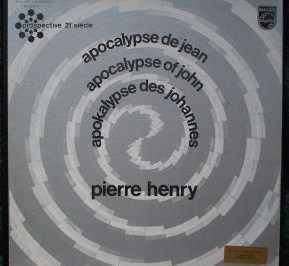
I had the pleasure of seeing Monsieur Henry perform in person in Paris in November 1997 at the Radio France building near the Eiffel Tower. On this occasion he performed his seminal tape collage piece “Apocalypse de Jean”. Although conforming to a more classical audience-stage set up, it was nonetheless a curious arrangement with nobody on stage, only a hundred or more speakers of differing sizes with Monsieur Henry at the back of the room at the mixing desk. The vinyl box set version of this work released on the seminal Prospective 21e Siècle label remains one of my most desired fetish objects.


Finally, while still on Pierre Henry, a book entitled “Pierre Henry’s House of Sounds” with an accompanying CDs of unreleased material was published earlier this year by  Gilka. The book is not, however, a standard biographical work, but instead a collection of Geir Egil Bergjord’s photos of Monsieur Henry’s house in Paris on Rue de Toul where he has lived and worked since 1971 and is thus an intimate visual portrait of the man with many clues as to his methods and thinking.

Monday, July 25, 2011

Cover Versions – The Jesus and Mary Chain

As a die-hard Jesus and Mary Chain fan, I couldn’t pass up the opportunity presented by this one: a new quasi-electronic shoe gaze cover of the JAMC track “Teenage Lust” originally released on the “Honey’s Dead” album.


The group performing the cover in question is newcomers Les Demoniaques, who are comprised of Kristin Gundred of the Dum Dum Girls and Tamaryn. The release comes as a one sided post card sized flexi disc from True Panther Sounds and available from Kompakt , if not sold out. An interesting feature of the track is that the all-female group essentially reclaims the originals slightly misogynistic rock stance to sex in a disembodied female form.


JAMC are of course no strangers to cover versions themselves, having released a mountain of them as B-sides and more throughout their career. One surprise is that perhaps there haven’t been more covers of JAMC tracks themselves over the years.

Earlier this year there appeared a vinyl-only unofficial JAMC release entitled “Send Me Away – Early Demos” which was a fascinating collection of primitive renditions of JAMC tracks. Some of these have appeared before, such as on the 4CD set “The Power of Negative Thinking”, but most were previously unreleased. Perhaps the significance of the album is a clearer-than-ever snap shot of the band’s sound in development, as here their influences are still coming together, such that many tracks wear their influence on their sleeve as a single origin, particularly punk rock, before they became awash with 50s and 60s Americana and essentially fused together into the JAMC sound.


One of their most important and overlooked demos is the “On the Wall” Portastudio version that appeared on the original “Darklands” single and the “Barbed Wire Kisses” compilation. There is nothing in their catalogue that sounds similar to this and with its proto-techno beats and its ringing, repetitive and hypnotic guitar it feels like a whole other band that could have come from this sound, a band with eyes on the dancefloor. And of course its feedback-drenched rain finale is sublime.